
OpenWorld Radio Twin#
Interactive, world-scale wireless digital twins. Pick any centre and radius on a globe or in a Python call, and receive a native Sionna RT scene with buildings, terrain, water and surface materials from open geodata. Simulate it with the upstream Sionna API, or expand it into seeded, reproducible radio-map datasets.
from openworld_radio_twin import rt as owrt

scene = owrt.load_scene(latitude=52.3762, longitude=4.8993, radius_m=250)
Version 0.2.1 · [Source on GitHub](https://github.com/zhiheng-yang/openworld-radio-twin) · Project page
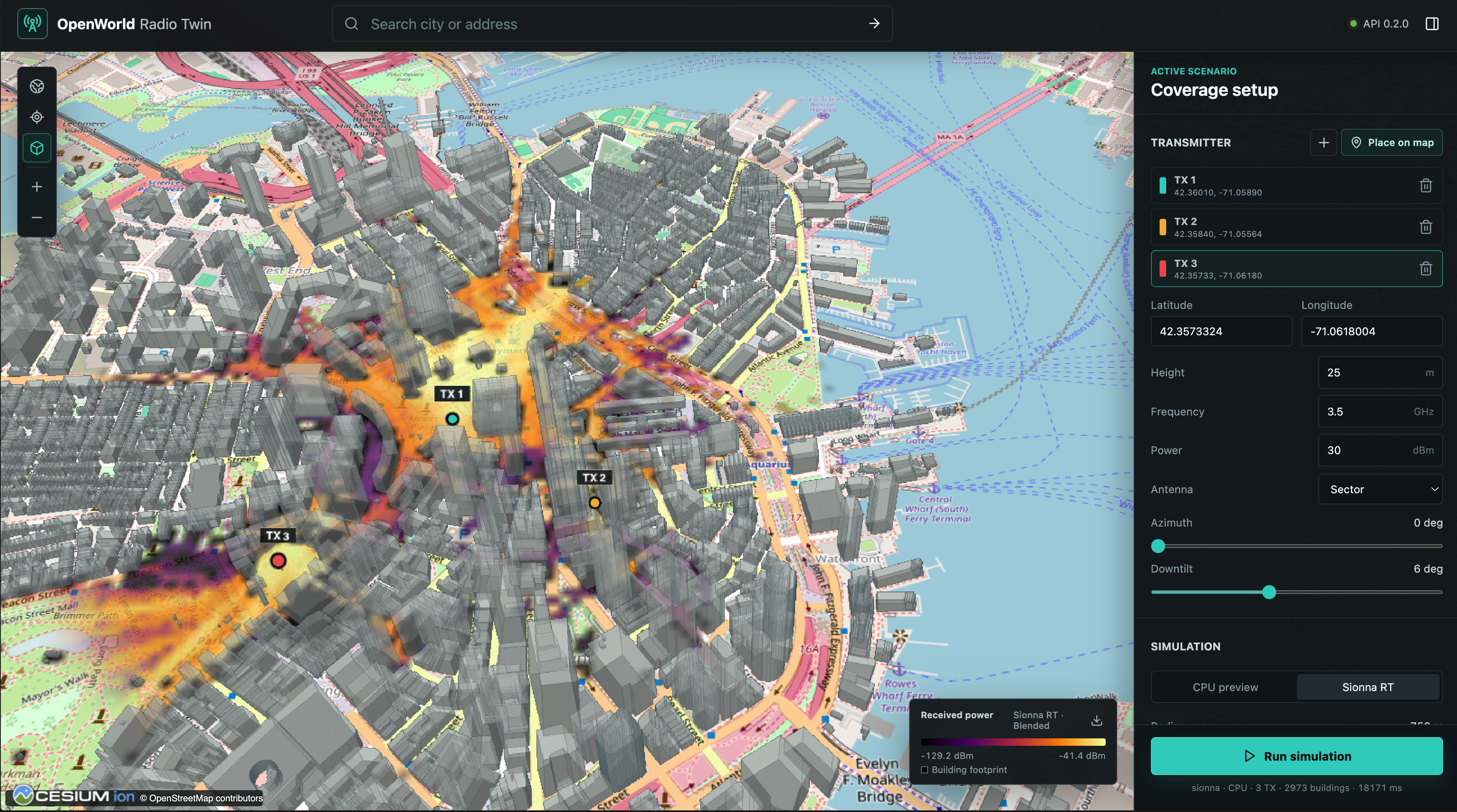
Install the package, load a first geographic scene, and open the browser explorer.
Buildings from regional and global sources, bare-earth terrain, water levelling, semantic surfaces and ITU material proxies, all in one local ENU frame.
Sionna RT with terrain-following measurement surfaces, and an analytical CPU preview for machines without a GPU.
Plan, generate, resume and extend seeded radio-map datasets from Python, the web page, or a cluster job.
Raw linear arrays, georeferenced PNGs, PLY meshes, voxel products and the provenance recorded with each of them.
Every public module, function and model, generated from the source.
How it fits together#
        flowchart LR
    A[Globe or Python call<br/>centre + radius] --> B[Scene compiler]
    B --> C[Buildings<br/>Overture · OSM · 3DBAG · Berlin · Boston]
    B --> D[Terrain<br/>USGS 3DEP · Mapzen Skadi]
    B --> E[Surfaces<br/>ground · vegetation · paved · water]
    C & D & E --> F[Native Sionna scene<br/>scene.xml + PLY meshes]
    F --> G[Sionna RT solvers]
    F --> H[CPU preview]
    G & H --> J[Radio maps · datasets · exports]
OpenWorld Radio Twin (OWRT) adds exactly two things to Sionna RT: a loader that compiles a scene from WGS84 coordinates, and helpers that convert geographic positions into the scene’s local frame. Antenna arrays, radio devices, solvers, radio maps, rendering and preview stay the upstream Sionna API. The same compiled scenes drive the browser explorer, the HTTP API, and the batch dataset generator.